

In this article, the third in a series of guides about UHF RFID technology, we look at the changing face of library security and how discreet solutions are often more effective than more obvious, visible deterrents.
Picture library security and most people see two grey pedestals either side of the door, a narrow gap between them, and a beep when something goes wrong. It’s so familiar that few people ask whether the exit needs to look like that.
Often, it doesn’t.
Why library security gates look the way they do
Older HF RFID systems read tags through near-field coupling: the antenna and the tag share a magnetic field, like two coils working together. That field fades very quickly with distance, so the read zone only reaches a short way out. To catch an item leaving, the antenna has to stand right beside the walkway, usually in pairs, one on each side, so nothing slips through the middle. A wider entrance means more pairs.
So the gates aren’t really a design choice. They’re what the physics needs. HF still does this job well in many libraries, and a working system needn’t be rushed out. But the hardware decides what your entrance looks like.
What eRLS RFID changes
UHF RFID works in the far field. The antenna sends out a radio signal and the tag reflects a reply back, so the read zone can be shaped and pointed where it’s needed, and the antenna no longer has to stand beside the walkway. It can sit overhead or in the floor and still watch the whole exit.
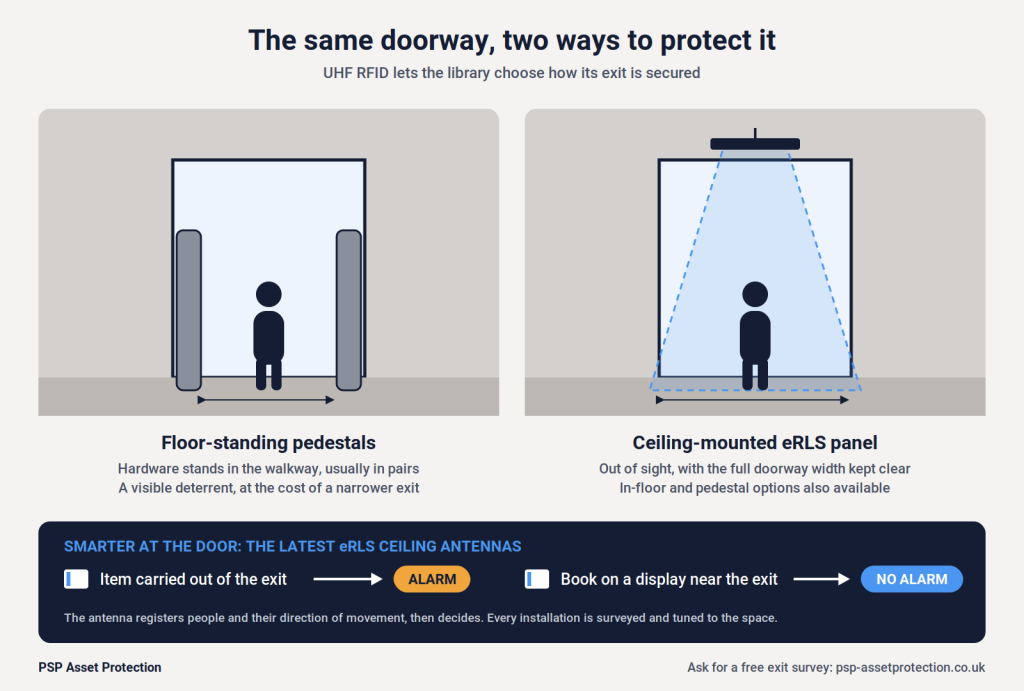
A single eRLS panel covers up to 3 metres, and panels can be linked for wider entrances. That means fewer units than pedestals, and the wider the entrance, the bigger the difference.
Three ways to protect an exit:
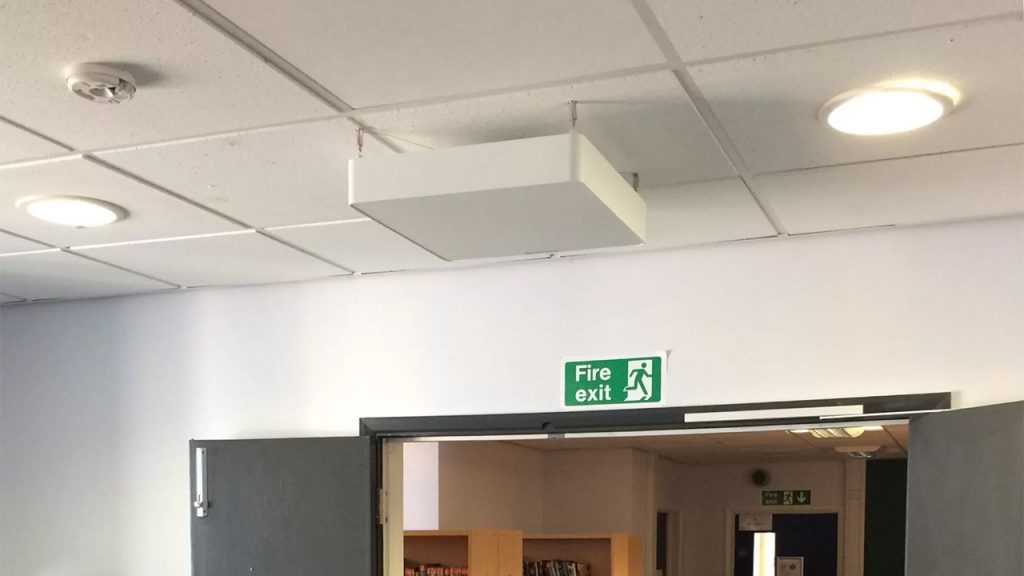
- Ceiling-mounted: out of sight, with no floor space lost.
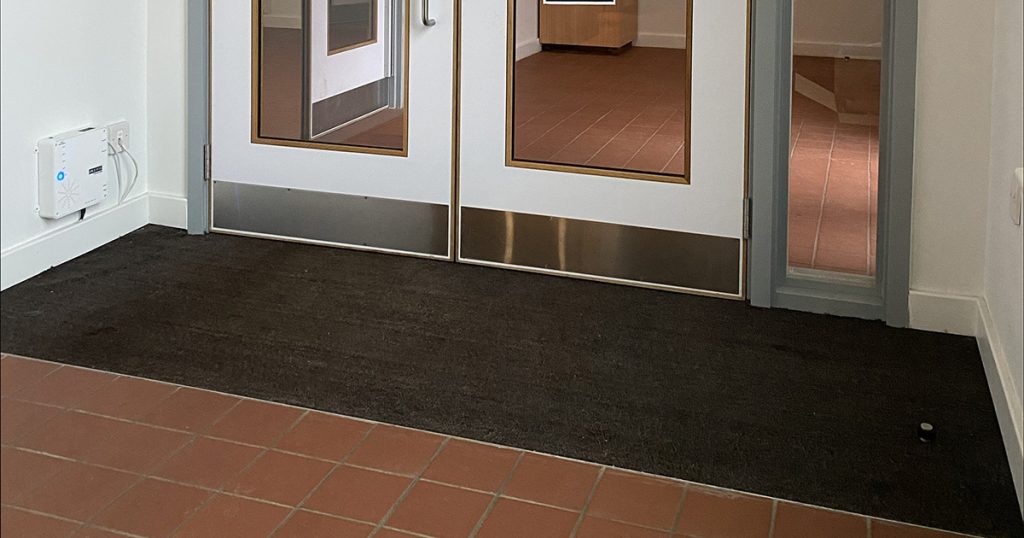
- In-floor: for open-plan or listed spaces where nothing should stand or hang. See our eRLS Mat page for more info.
- Pedestals: for libraries that want a visible deterrent. Now a choice, not a requirement.
Whichever you choose, alarms are both visual and audible.
What this means for library stock control day-to-day
The walkway stays clear, so wheelchairs, trolleys, not to mention a stampede of students, pass without squeezing through a gap. The door has no “cattle-grid” feel, and nothing sits in an evacuation route. It also opens up sites where gates struggle: shared entrances, wide openings, narrow corridors and access-restricted areas.
Hywel Dda University Health Board is a good example. Across its three NHS library sites, access restrictions such as narrow entryways meant security gates weren’t viable, so discreet ceiling antennas were the answer.
Smarter at the door
Older security systems react to any tagged item in range. The latest eRLS ceiling antennas detect the direction people are moving, so they alarm when an item is actually leaving, not when a book is sitting on a display near the exit. The antenna watches the exit with multiple beams, plus a small motion sensor that registers someone walking out, and combines the two before it decides whether to alarm.
Each installation is still surveyed and tuned to the space, because no exit system catches everything. But our modern UHF security is designed to stop real loss without false alarms that wear down staff and users.
Five questions to ask before you choose
- How wide is our entrance, and how many units will cover it?
- Can security be mounted out of sight if we prefer?
- Can the system tell the difference between an item leaving and an item near the door?
- What happens when an alarm sounds: do staff see anything beyond a beep?
- Will the installation affect accessibility or our fire exits?
The library entrance and exit is a design decision now
The entrance is the first thing visitors see and the last thing staff want to worry about. For a new build, refurbishment or first-time security installation, how your library is protected is now about space, access and appearance as much as security. It’s worth deciding on the preferred direction of travel before the design specification is written.
Planning a new library, refurbishment or first-time security installation? Get in touch with our friendly team for a free, no-obligation exit survey. We’ll show you what your entrance area could look like.
Next in this series: the standards question behind HF and UHF, and what it means for long-term compatibility.