

Your library’s resources extend beyond its shelves. Assess the technology, the assets it can protect, and the people who will make it work.
Understanding Ultra-High Frequency (UHF) RFID, read performance and library standards helps you assess the technology, but choosing a system means looking at the complete implementation. Whether you are introducing automated library security for the first time, or replacing an ageing installation, start with what your library needs to protect.
Of course, books are central to that conversation, but institution-owned loan laptops may belong in it too, making it worth looking beyond a books-only specification. This is where LapSafe® self-service smart lockers and charging stations could come in handy.
1. What library technology is actually proposed?
“RFID” describes a category, not a complete specification. Ask whether the proposal uses High Frequency (HF), UHF or a combination, and which functions the supplier can demonstrate today.
The quotation should identify the tags, entrance equipment, staff readers and software included. Separate working capabilities from optional equipment or future developments so you can compare like with like.
2. Can it protect more than books?
Start with books and institution-owned loan laptops, rather than assuming the security discussion stops at the shelves.
The information for PSP’s suite of best-in-class eRLS RFID products describes different tag formats for books, laptops and tablets, so the right question is which resources a proposed configuration can protect in your library.
That does not mean an ordinary book label will work on every device. Tag type, placement, device materials and the entrance read zone all affect performance; electronics containing metal may need purpose-designed on-metal tags and testing on representative devices.
Customer evidence: books and laptops at Kenilworth
Kenilworth School & Sixth Form added laptops to its eRLS system, with minor configuration adjustments. Staff reported being able to identify unissued books and laptops leaving the library, demonstrating a mixed-resource application rather than a books-only installation.
Ask: “Which non-book resources could be included, and can you demonstrate them using our actual items?”
Include representative device models and the bags in which they normally travel, not just an easy-to-read sample on a desk.
Tablets can be discussed where suitable tags, placement and configuration have been confirmed. Other loan equipment needs its own assessment, rather than being assumed to work because a laptop does.
Could the same UHF approach also help protect IT equipment, teaching aids or tools elsewhere in your institution? Suitable applications would need their own assessment, but a wider requirement could strengthen the business case and open a discussion about shared funding.
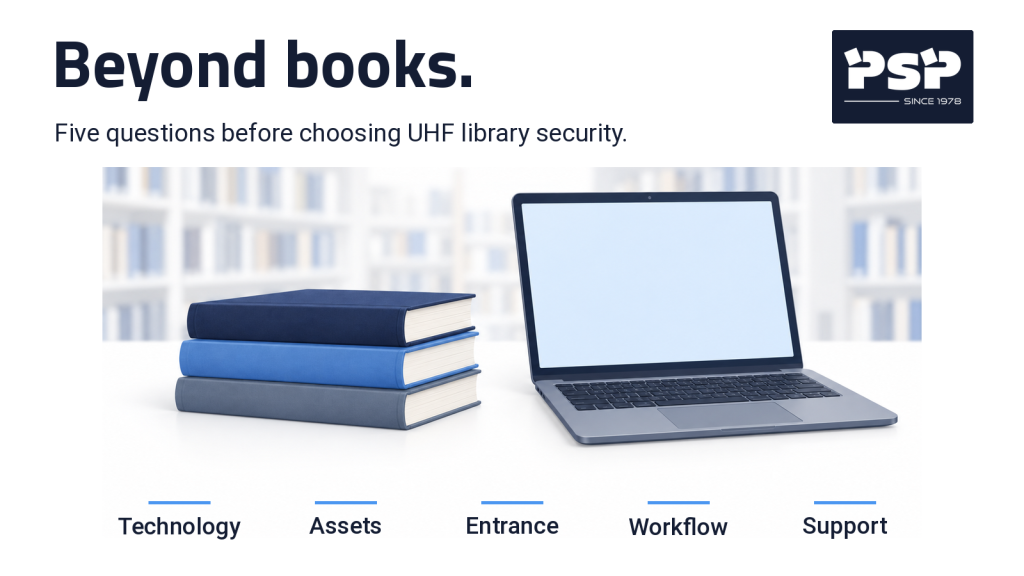
3. How will it fit the library entrance?
Ask how the proposed arrangement will preserve clear access and suit your building. Mounting, cabling, power, floor construction and installation access should be understood before an option becomes a commitment.
We document overhead panels, including ceiling suspension or mounting above a doorway using a wall bracket, and a separate floor-based eRLS Mat and Guard configuration. These are options to assess, not interchangeable components automatically included in every quotation.
A realistic demonstration should use representative tagged items, bags and normal traffic. Agree what satisfactory detection and alarm behaviour look like, including how unintended reads will be investigated.
4. How will the RFID solution work day to day?
Reading a tag identifies an item; the configured software and workflow determine whether its removal should raise an alert. Exit detection does not automatically identify the person carrying it.
For library loans, confirm how the security system receives issue and return information. Other equipment may need different records and processes, so agree these separately rather than assuming the library management system will handle them.
Walk through issue, return, alarm response and stock checking with staff. Confirm which tools are included and who uses them; entrance security alone is not a whole-library stocktaking service.
For a replacement project, clarify tagging, equipment changes, integration, training and disruption. Existing HF tags do not become readable by UHF equipment through a software update.
5. Who will deliver and support the new library stock control system?
Ask every supplier, including PSP, for relevant reference sites, named responsibility for installation and support, the service-plan scope and the complete implementation cost. Make sure the price covers the agreed tags, hardware, integration and training.
PSP is the UK specialist in discreet UHF RFID security and stock control for education and NHS libraries. Serving libraries since 1978, with more than 130 installations since 2017, PSP provides support from the people who install the system.
Tell us what you need to protect, from books to loan laptops, by booking a 15-minute, no-obligation call with our friendly team to discuss your library entrance area, current system, and practical upgrade options.